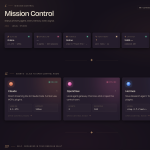
OpenClaw AI Mission Control System is the piece most people skip when they rush into building AI agents and only later realize their setup feels messy and fragile.
You can automate content, research, outreach, onboarding, and reporting, yet still struggle because you cannot clearly see how everything connects.
Speed feels productive at first, but without structure it quietly creates bottlenecks, duplication, and hidden failure points.
Watch the video below:
Want to make money and save time with AI? Get AI Coaching, Support & Courses
👉 https://www.skool.com/ai-profit-lab-7462/about
OpenClaw AI Mission Control System Solves The Visibility Problem
The core issue with multi-agent systems is not intelligence, it is lack of visibility across moving parts.
When agents run independently without centralized monitoring, you eventually lose track of which workflow triggered which output and whether the result met expectations.
OpenClaw AI Mission Control System creates a single operational layer where every task movement, agent action, and workflow stage is visible in real time.
That means you can see what is currently active, what is waiting for review, and what has successfully completed without manually checking five different tools.
Instead of discovering errors after results drop, you identify friction immediately because logs and transitions are tracked automatically.
Clarity changes your behavior because you move from reacting to problems toward proactively refining processes.
Confidence grows when automation becomes observable rather than mysterious.
Designing Systems With OpenClaw AI Mission Control System
Automation fails when people focus on adding more agents instead of improving structure.
OpenClaw AI Mission Control System encourages system thinking by forcing workflows into defined stages with clear transitions.
Rather than firing random prompts, you design boards that represent real operational pipelines from idea to delivery.
Tasks move through backlog, execution, validation, and completion with agents assigned specific responsibilities at each step.
This design reduces overlap because every stage has a purpose and every agent has a defined role.
Structured systems allow predictable scaling since each new workflow plugs into an existing framework rather than creating a new isolated path.
Consistency becomes easier because processes are repeatable and visible.
Systems thinking is what separates experimentation from real operational leverage.
Managing Agent Lifecycle The Right Way
Agents evolve over time as business goals shift and integrations change.
OpenClaw AI Mission Control System allows you to monitor performance, adjust instructions, and refine workflows without rebuilding everything from scratch.
You can review execution history to understand exactly how decisions were made and where improvements are needed.
If an API changes or a prompt begins producing inconsistent outputs, you can intervene quickly because the activity trail shows precise behavior.
Lifecycle management transforms agents from static scripts into adaptive contributors that improve through iteration.
Instead of abandoning broken automations, you refine them within a controlled environment.
Long term stability depends on this ability to observe, adjust, and optimize continuously.
Multi-Agent Collaboration Without Chaos
Complex objectives require collaboration between specialized agents rather than relying on one overloaded system.
Inside OpenClaw AI Mission Control System, a manager agent can interpret a high level goal and divide it into structured subtasks.
Research agents gather data, drafting agents convert insights into content, formatting agents prepare outputs, and validation agents review quality.
All of this happens in parallel while mission control tracks progress at every stage.
Central oversight ensures that outputs return to a controlled review stage before final completion.
Coordination eliminates duplication because responsibilities are clearly defined and tracked.
Structured collaboration creates speed without sacrificing alignment.
Parallel execution becomes a strength instead of a source of confusion.
Cost Control Through Smart Orchestration
Resource waste often happens when every task uses maximum computational power by default.
OpenClaw AI Mission Control System allows you to allocate lightweight models for routine formatting or categorization tasks while reserving advanced reasoning for complex analysis or strategy.
Matching capability to complexity protects margin while maintaining performance quality.
You gain the flexibility to layer intelligence instead of applying the same level to everything.
That layered approach prevents runaway expenses and supports predictable budgeting.
Smart orchestration turns cost control into a built in feature rather than a reactive adjustment.
Efficiency improves because the system is designed to think strategically about resource allocation.
Integration And Governance That Actually Holds Up
As automation expands, integration complexity becomes the hidden risk factor.
OpenClaw AI Mission Control System centralizes runtime governance so agents connect to external tools through a structured layer rather than scattered configurations.
Permissions, API access, and data flows are controlled from one environment, reducing the chance of hidden dependencies or security gaps.
When something changes externally, you can trace its impact across workflows because connections are logged and monitored.
Governance provides resilience since you can identify and resolve disruptions quickly.
Infrastructure built deliberately handles growth better than automation assembled through shortcuts.
Durability comes from controlled integration, not from rapid expansion.
Thinking Of OpenClaw AI Mission Control System As An Operating Layer
Many people still treat AI as a reactive assistant that responds to isolated prompts.
OpenClaw AI Mission Control System reframes AI as an operating layer that runs continuous workflows in the background.
Tasks move through structured pipelines without requiring constant manual prompting.
Agents collaborate automatically while you focus on strategy rather than execution.
This shift creates leverage because output continues even when you are not directly interacting with the system.
Operational consistency replaces sporadic bursts of productivity.
Viewing AI as infrastructure changes how you plan growth because you design processes instead of chasing tasks.
Leverage compounds when workflows are reliable and visible.
Practical Setup Strategy For OpenClaw AI Mission Control System
Implementation should begin with a single workflow that directly impacts your core operations.
Deploy using containerized environments for stability or manual configuration if you need deeper customization.
Observe how tasks move across stages before adding complexity.
Testing each board and agent team thoroughly ensures that expansion builds on a solid foundation.
Gradual iteration reduces risk because improvements are based on observed behavior rather than assumptions.
Rushing into full scale automation often introduces more confusion than efficiency.
Steady refinement strengthens reliability, and reliability supports long term scalability.
The AI Success Lab — Build Smarter With AI
👉 https://aisuccesslabjuliangoldie.com/
Inside, you’ll get step-by-step workflows, templates, and tutorials showing exactly how creators use AI to automate content, marketing, and workflows.
It’s free to join — and it’s where people learn how to use AI to save time and make real progress.
If you want to explore the full OpenClaw guide, including detailed setup instructions, feature breakdowns, and practical usage tips, check it out here: https://www.getopenclaw.ai/
Frequently Asked Questions About OpenClaw AI Mission Control System
-
What does OpenClaw AI Mission Control System actually do?
It centralizes and orchestrates multiple AI agents so workflows remain structured, visible, and manageable. -
Is OpenClaw AI Mission Control System only for advanced users?
While technical familiarity helps, incremental setup and structured guidance make it accessible to serious beginners. -
Can OpenClaw AI Mission Control System handle multiple boards at once?
Yes, it is built to manage parallel workflows without losing coordination or oversight. -
Does OpenClaw AI Mission Control System reduce long term costs?
Strategic model allocation and centralized governance improve efficiency and protect operational margin. -
Why is OpenClaw AI Mission Control System important for scaling?
Structured visibility prevents chaos as agent count and workflow complexity increase over time.